Setting the National Frame
Australia’s next phase of growth isn’t simply about height, speed or scale. It’s about how places perform over time, economically, socially and culturally, as Australian cities move into a more complex and constrained phase of development. This is not a theoretical shift. It is something we are seeing firsthand across the projects we are working on, from inner-city environments to emerging growth corridors.
At its core, this work spans how people move through life. From early learning environments through to homes, workplaces, hospitality venues and into independent and senior living, the role of place is continuous. We are increasingly working across this full spectrum, shaping environments where people live, learn, work, play and rest at different stages of life. This brings a responsibility to think beyond individual projects and consider how identity, experience and function connect over time. Places are no longer isolated moments. They are part of a broader, lived system.
The Changing Shape of Urban Growth
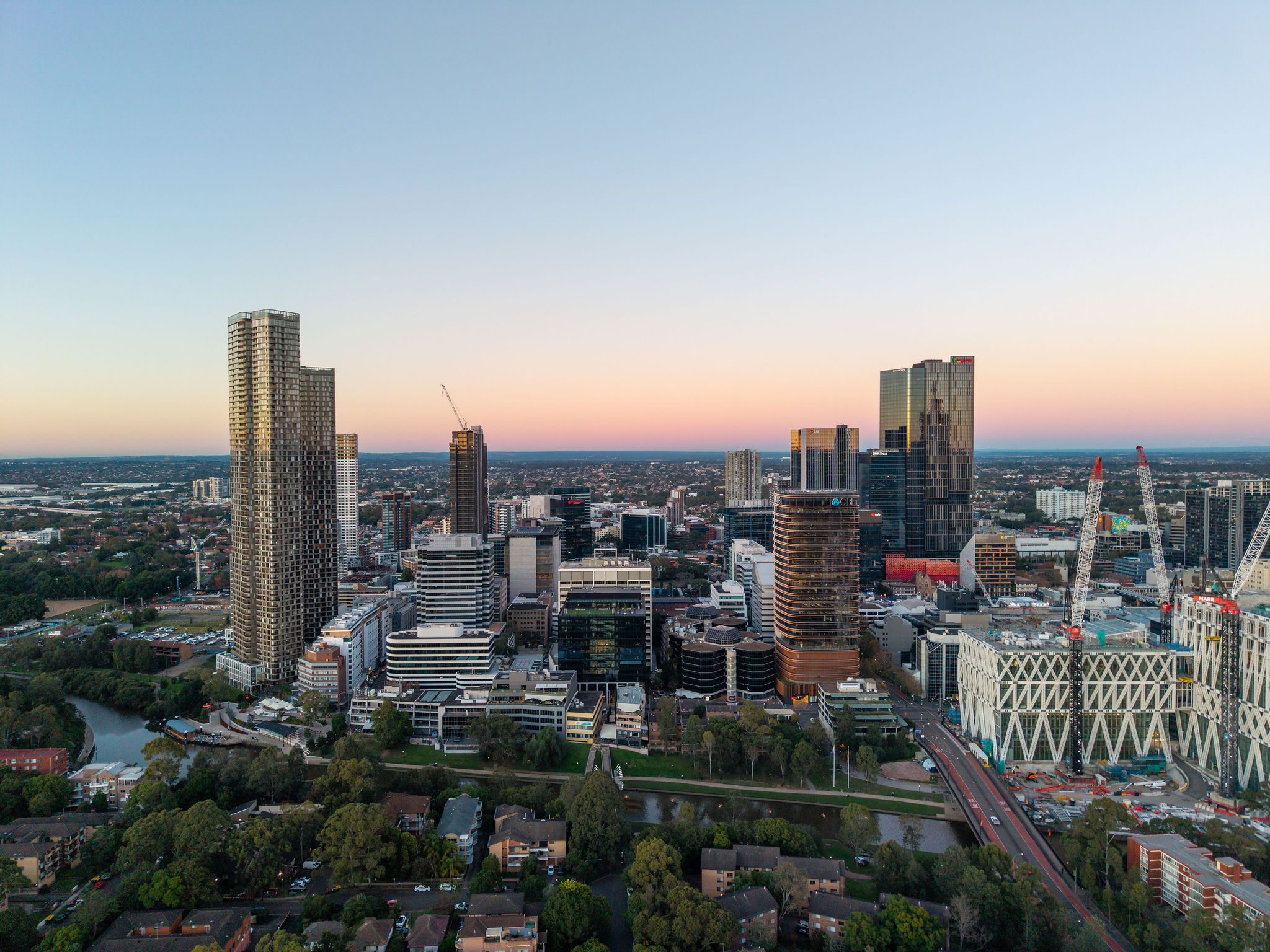
In established cities like Sydney, growth is layered and compressive. Our work is increasingly focused on new ways of living within premium, well-established villages and peninsulas, as well as emerging communities forming along new metro lines. These are not blank-slate environments. They come with expectation, of quality, of lifestyle, of belonging, and the challenge is to introduce something new without disrupting what people already value.
In this context, value is not created through scale or visual impact. It comes from clarity and authenticity. Each project needs a clear position within its local setting, a lifestyle story that feels both compelling and grounded, not imposed. Along new metro corridors in particular, where entirely new villages and airport city centres are taking shape, identity plays a critical role in shaping how these places are understood from day one. It’s not just about naming or branding, but about establishing a narrative that connects to how people want to live, move and belong.
Clarity as a Measure of Quality
This requires a level of precision. Through our work at the highest end of the market, including our engagement with Capella, we understand that luxury is not defined by excess. It is defined by restraint, by coherence, and by the confidence to do less, better. That same thinking applies across residential and mixed-use developments. Identities need to be considered, resolved and enduring, able to support approvals, guide design decisions and maintain relevance as projects evolve.
Here, people-centric outcomes are not aspirational. They are essential. In environments where expectation is high and margin for error is low, clarity becomes the mechanism that holds everything together, commercially, experientially and over time.
Growth Corridors and Emerging Centres
South-East Queensland presents a different condition. Our work across Brisbane and extending into the broader growth corridors highlights a region defined by speed and scale. Large precincts, new centres and infrastructure investment are shaping entirely new parts of the city. The opportunity is significant, but so is the exposure. Without clear identity frameworks and considered sequencing, speed can produce places that meet immediate demand but struggle to differentiate, mature or retain value. We are seeing this particularly in emerging town centres and mixed-use precincts, where early decisions around naming, positioning and wayfinding set the trajectory for how a place is understood or overlooked.
Across both contexts, a consistent pattern is emerging. Precincts that are legible, intuitive and grounded in daily life perform better. In our experience working across commercial workplaces, hospitality venues and large-scale residential developments, places that are easy to navigate, clearly positioned and aligned in their identity attract stronger engagement. They lease faster, hold value more effectively and adapt more easily as market conditions shift. Clarity, in this sense, becomes a form of risk management.
From Projects to Places
Australian developers are increasingly recognising this and taking a longer-term view of their assets. At the same time, feasibility pressures are real. Higher interest rates, cautious buyers and rising construction costs, compounded by sustained government infrastructure investment, mean projects must still deliver near-term returns. The tension is constant: how to meet immediate commercial realities without eroding long-term value.
This is where a strategically led creative approach becomes critical. From our work across precinct identities, commercial repositioning and hospitality experiences, it is clear that brand, placemaking and wayfinding cannot be applied late or treated as surface expression. When considered early, they act as infrastructure, aligning teams, guiding decision-making and creating a consistent thread from concept through to delivery and operation.
The shift underway is clear: from projects to places, from speed to coherence, and from short-term optimisation to long-term resilience. As Australian cities continue to evolve, the developments that endure will be those shaped with clarity and intent, grounded in how people move, live and belong, and informed by the realities of delivering value in an increasingly complex market.
Articles

04.11.2025
South East Queensland – A region in motion
Southeast Queensland is entering a defining decade. With record population growth, city-shaping investment and the 2032 Olympics on the horizon, the region is alive with opportunity. Learn how Extrablack helps developers and asset owners define, position and activate projects that thrive in this new landscape.
Contact
To get in touch...