

Longevity is the next luxury.
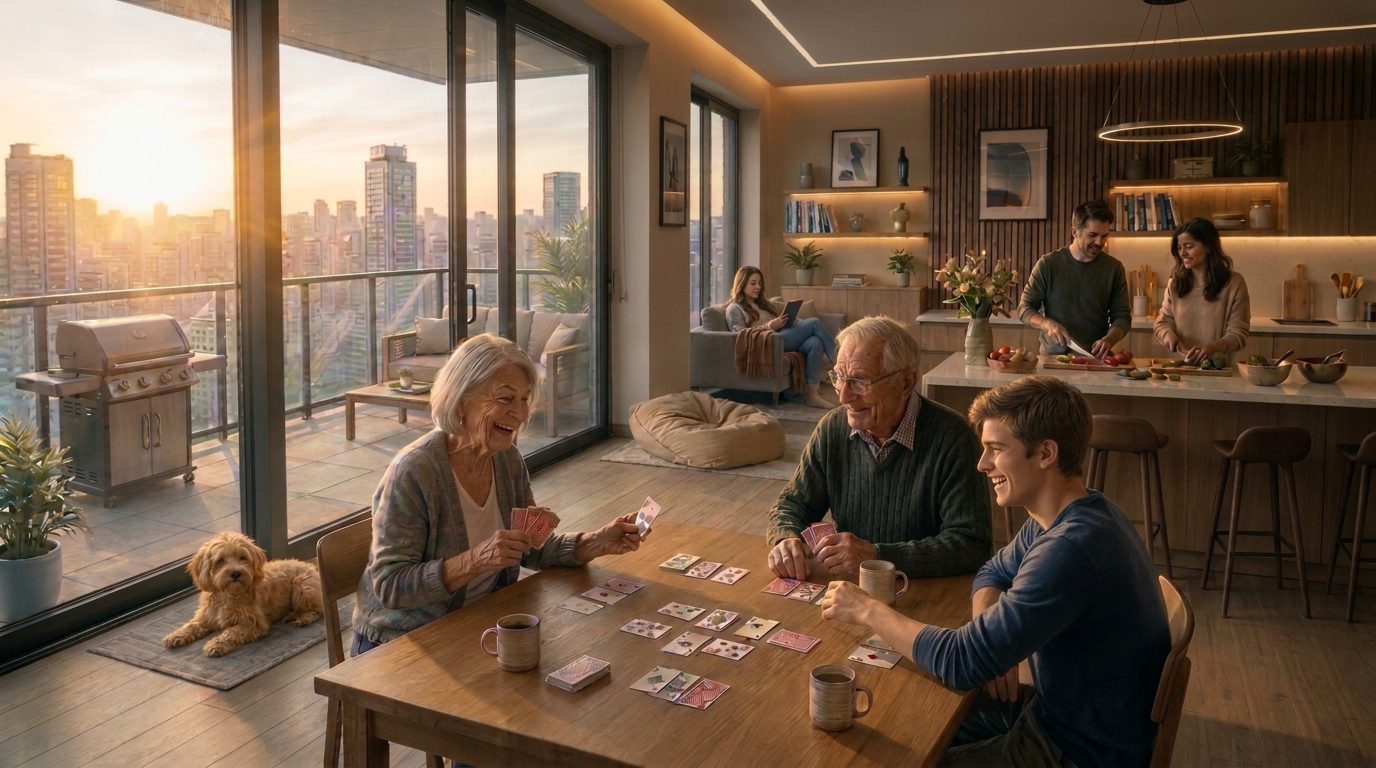
How we live is changing.
The generational make-up of the Australian home is shifting, yet the homes on offer have barely moved.
ABS projections show the number of Australians living with relatives beyond the immediate family rising from around 637,000 in 2021 to roughly 906,000 by 2041. That’s growth of up to 52%, well ahead of population growth of 27%. The fastest-rising group? People aged 80 and over, whose likelihood of living with family could climb from 10% to as high as 17%.
Closer to home, the shift is sharper still. In Greater Brisbane, the number is projected to grow by 50% to 65% by 2041, around double the city’s population growth. Sydney already has the highest concentration in the country, with close to 3% of residents living this way, and that share keeps climbing.
Australia is facing two housing crises at once, and they're quietly colliding.
On one side, younger Australians are priced out of ownership, staying in the family home for longer or stretching to buy on their own. On the other, an ageing population is putting mounting pressure on aged care. The ABS projects that the number of people aged 85 and over living in care and other non-private settings could rise from around 121,000 in 2021 to as many as 321,000 by 2046. The two problems are usually treated in isolation, with separate policies, separate products and separate developers. Yet the same family is often living both at once: adult children who can’t afford to buy, and parents who’d rather not move into care.
To be fair, a select few developers are starting to bridge the gap. They’re testing dual-key layouts, adaptable floorplans and wellbeing amenity built for every stage of life. It’s encouraging to see, and it shows the appetite is there. The challenge now is moving from the occasional pioneer to a genuine new category of home.
Multigenerational homes bring those needs under one roof.
Combining resources can put a larger, better-located home within reach, while having family close by helps an older parent stay independent for longer and eases the strain on care services. It isn’t without complexity. Title structures, family agreements, pension rules and estate planning all need careful thought, and the legal and financial frameworks are still catching up. It won’t solve either crisis on its own, but it’s one of the few answers that tackles both together.
The challenge isn’t a lack of will. Until finance, planning and legal frameworks catch up, and until there’s a proven market to point to, the numbers rarely stack up. That’s where clear positioning and compelling design can help, by showing developers, lenders and buyers that the demand is real.
Now picture a typical residential tower.
One, two and three bedrooms, a penthouse on top, retail at ground level and perhaps a podium to level five. It’s a formula built for a household that’s becoming less typical every year.
Meanwhile, longevity and wellbeing design is arriving in Australia. Luxury no longer just means beautiful finishes. More mature buyers are weighing up the quality of their next stage of life, and developers are answering with ice plunge baths, saunas, red light therapy and other bio-support amenity.
All welcome. But one of the least glamorous and most influential ways to extend a life is being overlooked: living with family. Staying connected, needed and cared for across generations is one of the strongest foundations for a long, healthy life.
It’s practical, too. Grandchildren gain carers, mentors and an everyday connection to their family’s story. Parents gain help with childcare, and a little peace of mind.
Scour the market and you’ll find very few homes, apartments especially, designed with the later stages of life fully considered and for a multigenerational family to buy together.
So imagine this.
A generous apartment of three, four, even five bedrooms. Wide hallways. Two living spaces, one with a full kitchen, the other with a kitchenette and its own balcony. Smart home technology wired in to support the daily health and wellbeing of everyone under the roof, from grandchildren to grandparents.
The technology that makes it work
The real opportunity lies in the technology, provided it’s designed in from day one rather than bolted on later. Done well, it fades into the background and quietly looks after everyone.
Safety without surveillance. Radar-based sensors can detect a fall without a single camera, alerting family members wherever they are, in the home or beyond it. For a grandparent who values their privacy, that difference matters enormously.
Routines that speak up. Ambient sensors learn the rhythm of a household: when the kettle goes on, when doors open, how well someone sleeps. When a pattern changes, such as a later morning or a restless night, the right family member gets a gentle nudge. No wearable to forget, no button to press.
Light that follows the body clock. Circadian lighting shifts in colour and intensity through the day to support better sleep, while low-level path lighting switches on automatically for a night-time trip to the bathroom.
Comfort, zone by zone. Individual climate control lets a grandparent’s suite run a few degrees warmer than a teenager’s bedroom, with air quality monitoring keeping the whole home healthy.
Care on call. A quiet, well-lit space wired for telehealth makes a GP appointment as easy as a video call with the grandkids. Voice assistants take care of medication reminders and family calendars for every generation.
Togetherness, with a door that closes. Smart locks with individual access, separate entries and acoustic zoning let each generation come and go on its own terms. Living together works best when everyone can also live apart.
None of this is futuristic. The technology exists today. What’s missing is a building that brings it together with the right floorplan, the right amenity and the right brand story for families making one of the biggest decisions of their lives.
That’s not a niche product. On the numbers, it’s the next premium apartment.
Source: ABS, Household and Family Projections, Australia, 2021 to 2046.
Contact
To get in touch...