

The Indepedence Gap
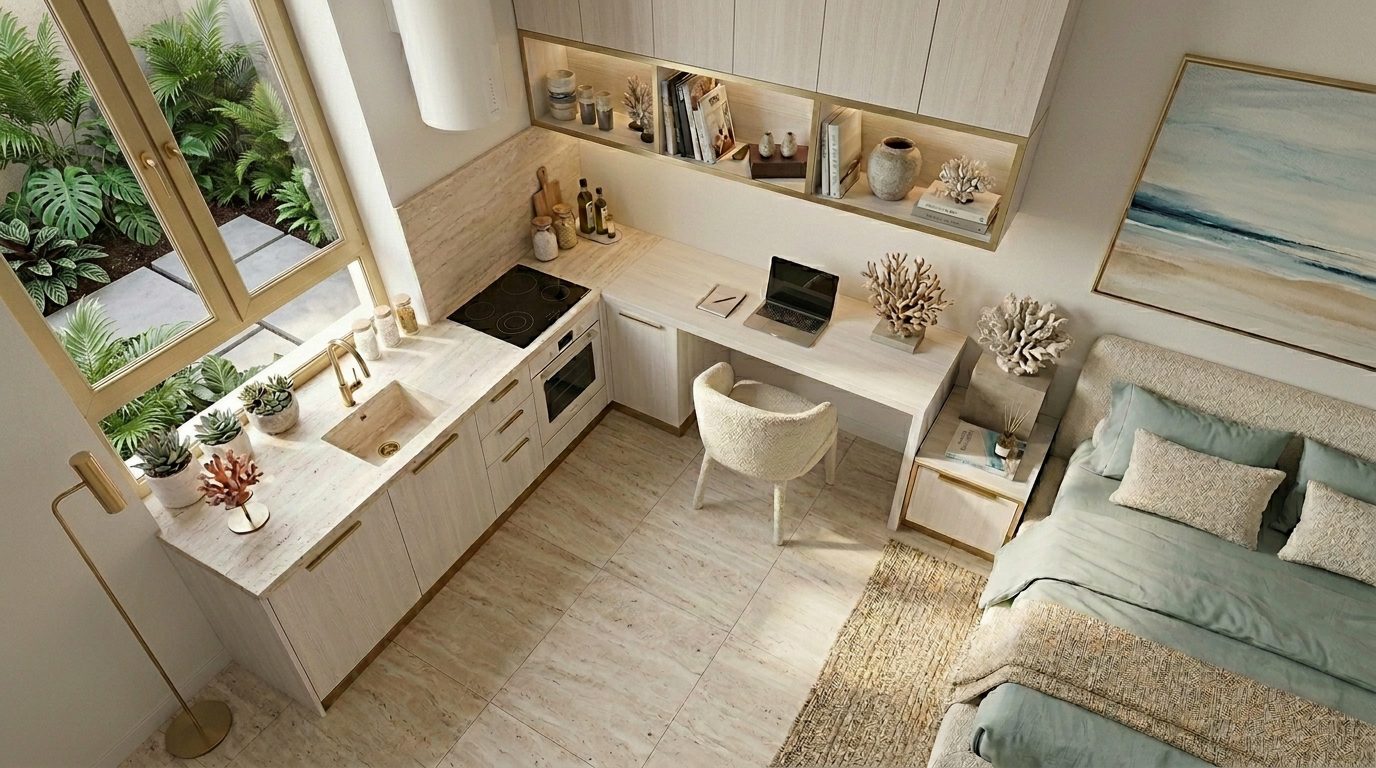
The independence gap: why a generation ready to leave home can't get the keys.
Walk through Iglu Central Park in Chippendale, or Scape Abercrombie nearby. Hundreds of young people live in rooms smaller than most living rooms. A double bed. A kitchenette. A compact ensuite. A desk built for a proper screen setup. All within thirteen to twenty square metres. Near-full occupancy. Waitlists in peak season.
None of these residents own the room they live in. Offer that same studio for sale to a twenty-three-year-old as their first home, and the deal collapses before it starts. Most major banks won’t lend against it. Mortgage insurers won’t underwrite it. In New South Wales, planning law prevents it existing as a titled apartment at all.
Worth being clear on something here. Roughly a quarter of these residents are domestic students, the majority international. The occupancy data confirms the design works. It doesn’t, on its own, confirm Australian demand for ownership. That distinction is worth holding onto through everything that follows. The design case stands on its own evidence. The ownership case is the argument this piece makes, and it’s not about towers of micro studios, it’s about creating a new dwelling class that is supported by the system and becomes another product to be considered in the mix for residential projects.
A generation too large to keep ignoring
Millennials are Australia’s largest generational cohort. Add Gen Z, and together they made up 47% of the electorate at the last federal election, ahead of Baby Boomers for the first time. Globally, both cohorts are projected to make up nearly three quarters of the workforce within a few years. This is the customer base, workforce and electorate every bank, insurer and government department already depends on.
Housing affordability consistently ranks as their primary concern. The reasoning is sound. Size and deposit thresholds were set decades ago, when fifty square metres was considered a reasonable first apartment and a twenty per cent deposit was achievable rather than aspirational. Those thresholds haven’t moved. The buyers underneath them have changed completely.
Twenty-five years ago, a home cost four to five times the median wage. Today it costs eight to thirteen, depending on the city. Wages didn’t triple. The ownership door simply narrowed for the generation now trying to walk through it, and planning, lending and insurance settings stayed exactly where they were.
One question deserves a direct answer. Won’t a declining birth rate shrink tomorrow’s buyer pool? Australia’s fertility rate sits at a record low of 1.42. This isn’t the number that matters most. Studios are bought by a rolling window of eighteen to thirty year olds, and that pipeline is sustained by migration as much as births. Migration is a lever government actively manages. Fertility isn’t. Every current population projection has Australia growing, not shrinking, through mid-century. Lone-person households are also the fastest-growing household type, independent of birth rate, and that trend alone sustains demand for smaller dwellings. A genuine fertility-driven shortfall in this exact buyer cohort wouldn’t appear before 2045 to 2055, and only if migration policy also pulled back over the same period. Neither reflects the current trajectory.
The system already knows how to flex, just not for ownership
New South Wales has already created a land use category for this. Co-living housing allows compact private rooms alongside shared amenity, and it works. Developers are building thousands of these studios as student accommodation and build-to-rent stock, backed by institutional capital. Smaller operators are applying the same model at house-and-land scale, converting single dwellings into micro-apartments for investors seeking double the standard rental yield. Melbourne and Brisbane don’t carry a legislated minimum apartment size at all.
The regulatory capacity clearly exists. Lenders are comfortable financing a tower of hundreds of small studios, provided one institution owns the building and rents it back indefinitely. No equivalent pathway exists for a young person to own one of those studios outright. Subdivide a building into six small rooms under single ownership, and the planning system supports it. Offer one of those same rooms for sale to the person living in it, and no category applies.
A closed loop nobody's tested
Ask why a bank won’t lend against a well-built and architecturally designed eighteen square metre studio, and the answer returns to resale risk. The reasoning is circular. Limited finance restricts buyers, restricted buyers thin the resale market, and the thin resale market is then used as evidence the original caution was justified.
The same pattern holds across all three frameworks. Planning guides regulate floor area as a proxy for liveability, rather than assessing whether a compact home is genuinely well designed. Lending rules price risk against historical patterns for an asset class that has never been permitted to exist in owner-occupied form. Insurance follows the lending position rather than testing it independently. None of the three has been measured against the evidence already available: years of near-full occupancy in exactly this format.
The same friction appears at smaller scale. A house-and-land co-living conversion in outer Sydney runs into a building classification that shifts at exactly four tenants, financing that moves this from residential to commercial terms.
Where the reform conversation is missing, and what would change it
Millennials and Gen Z now represent the country’s dominant voting bloc, and housing affordability is what they say matters most. Reform to date has focused on the rental side: build-to-rent tax settings, boarding house density bonuses, co-living planning categories. The ownership side hasn’t been addressed.
Three changes would close the gap. Planning bodies should introduce a design-certified compact apartment category, assessed on genuine liveability rather than floor area alone. Lenders and their regulators should re-test minimum size thresholds against a decade of real occupancy data and dramatically improved design, rather than an inherited assumption that has never been checked. First-home ownership schemes should extend explicitly to this category, recognising that a smaller deposit into a smaller, well-designed home is precisely the independent step into adulthood that is currently being made almost impossible to achieve.
Adding to the system that needs re-testing is the supply challenge.
The value this creates
Strip away the policy detail, and the person at the centre of this is straightforward. Someone recently out of their family home, learning to manage their own space and routine for the first time. A double bed against the same wall as a desk that folds away. A kitchenette sized for a proper meal. Enough room to build genuine independence, without requiring a level of capital that puts it out of reach.
Size was never the real measure. Design quality is. An eighteen square metre studio with proper storage, high ceilings, natural light and considered finishes outperforms a poorly designed forty-five square metre apartment on almost every measure that matters. That’s not a compromise position. It’s the design profession’s own conclusion.
Owning a home like this isn’t a smaller version of the housing someone will eventually want. It’s the natural first step towards it, the same step every generation before this one was allowed to take.
The market has already proven this model works. The only barrier between a rented room and a genuinely owned first home is a set of settings that hasn’t been revisited in years. That’s not a design constraint. It’s a decision still waiting to be made and who is prepared to lead this reform? I look forward to explore this over a series of articles.
Articles

07.05.2026
Shaping the Next Generation of Australian Places
Australia’s cities are entering a more complex phase of growth. From emerging metro corridors to established urban villages, successful developments increasingly rely on strategic placemaking, clear identity and people-focused design to create places that endure socially, commercially and culturally.


13.05.2026
A Clearer Expression of Extrablack
Extrablack’s recent brand refresh reflects the evolution of the studio from a design-led practice into a strategic brand and business solutions partner. The article explores how clarity, alignment and integrated thinking are becoming essential across increasingly complex projects within the built environment.
Contact
To get in touch...